Friday, September 10, 2010

How Are Satellite Orbits Predicted?


Special satellite software, available for personal computers, predicts satellite orbits. The software uses Keplerian data to forecast each orbit and shows when a satellite will be overhead. The latest "Keps" are available on the Internet for amateur radio satellites, too. 


Satellites use a variety of light-sensitive sensors to determine their position. The satellite transmits its position to the ground station. 

What Are the Types of Satellite Orbits?


There are three basic kinds of orbits, depending on the satellite's position relative to Earth's surface:
Geostationary orbits (also called geosynchronous or synchronous) are orbits in which the satellite is always positioned over the same spot on Earth. Many geostationary satellites are above a band along the equator, with an altitude of about 22,223 miles, or about a tenth of the distance to the Moon. The "satellite parking strip" area over the equator is becoming congested with several hundred television, weather and communication satellites! 

This congestion means each satellite must be precisely positioned to prevent its signals from interfering with an adjacent satellite's signals. Television, communications and weather satellites all use geostationary orbits. Geostationary orbits are why a DSS satellite TV dish is typically bolted in a fixed position.  


The scheduled Space Shuttles use a much lower, asynchronous orbit, which means they pass overhead at different times of the day. Other satellites in asynchronous orbits average about 400 miles (644 km) in altitude.


In a polar orbit, the satellite generally flies at a low altitude and passes over the planet's poles on each revolution. The polar orbit remains fixed in space as Earth rotates inside the orbit. As a result, much of Earth passes under a satellite in a polar orbit. Because polar orbits achieve excellent coverage of the planet, they are often used for satellites that do mapping and photography.

    What is Inside a Typical Satellite?


    Satellites come in all shapes and sizes and play a variety of roles. For example:
    • Weather satellites help meteorologists predict the weather or see what's happening at the moment. Typical weather satellites include the TIROS, COSMOS and GOES satellites. The satellites generally contain cameras that can return photos of Earth's weather, either from fixed geostationary positions or from polar orbits.
    • Communications satellites allow telephone and data conversations to be relayed through the satellite. Typical communications satellites include Telstar and Intelsat. The most important feature of a communications satellite is the transponder -- a radio that receives a conversation at one frequency and then amplifies it and retransmits it back to Earth on another frequency. A satellite normally contains hundreds or thousands of transponders. Communications satellites are usually geosynchronous.
    • Broadcast satellites broadcast television signals from one point to another (similar to communications satellites).
    • Scientific satellites perform a variety of scientific missions. The Hubble Space Telescope is the most famous scientific satellite, but there are many others looking at everything from sun spots to gamma rays.
    • Navigational satellites help ships and planes navigate. The most famous are the GPS NAVSTAR satellites.
    • Rescue satellites respond to radio distress signals (read this page for details).
    • Earth observation satellites observe the planet for changes in everything from temperature to forestation to ice-sheet coverage. The most famous are the LANDSAT series.
    • Military satellites are up there, but much of the actual application information remains secret. Intelligence-gathering possibilities using high-tech electronic and sophisticated photographic-equipment reconnaissance are endless. Applications may include:
      • Relaying encrypted communications
      • Nuclear monitoring
      • Observing enemy movements
      • Early warning of missile launches
      • Eavesdropping on terrestrial radio links
      • Radar imaging
      • Photography (using what are essentially large telescopes that take pictures of militarily interesting areas)
    Despite the significant differences between all of these satellites, they have several things in common. For example:
    • All of them have a metal or composite frame and body, usually known as the bus. The bus holds everything together in space and provides enough strength to survive the launch.
    • All of them have a source of power (usually solar cells) and batteries for storage.
    Arrays of solar cells provide power to charge rechargeable batteries. Newer designs include the use of fuel cells. Power on most satellites is precious and very limited. Nuclear power has been used on space probes to other planets (read this page for details). Power systems are constantly monitored, and data on power and all other onboard systems is sent to Earth stations in the form of telemetry signals. 

    • All of them have an onboard computer to control and monitor the different systems.
    • All of them have a radio system and antenna. At the very least, most satellites have a radio transmitter/receiver so that the ground-control crew can request status information from the satellite and monitor its health. Many satellites can be controlled in various ways from the ground to do anything from change the orbit to reprogram the computer system.
    • All of them have an attitude control system. The ACS keeps the satellite pointed in the right direction.
    The Hubble Space Telescope has a very elaborate control system so that the telescope can point at the same position in space for hours or days at a time (despite the fact that the telescope travels at 17,000 mph/27,359 kph!). The system contains gyroscopes, accelerometers, a reaction wheel stabilization system, thrusters and a set of sensors that watch guide stars to determine position.

    What is a Satellite Launch Window?


    A launch window is a particular period of time in which it will be easier to place the satellite in the orbit necessary to perform its intended function. 

    With the Space Shuttle, an extremely important factor in choosing the launch window is the need to bring down the astronauts safely if something goes wrong. The astronauts must be able to reach a safe landing area where rescue personnel can be standing by. For other types of flights, including interplanetary exploration, the launch window must permit the flight to take the most efficient course to its very distant destination. If weather is bad or a malfunction occurs during a launch window, the flight must be postponed until the next launch window appropriate for the flight. If a satellite were launched at the wrong time of the day in perfect weather, the satellite could end up in an orbit that would not pass over any of its intended users. Timing is everything!


    Orbital Velocity and Altitude


    A rocket must accelerate to at least 25,039 mph (40,320 kph) to completely escape Earth's gravity and fly off into space (for more on escape velocity, visit this article at kidsplanet.com).
    Earth's escape velocity is much greater than what's required to place an Earth satellite in orbit. With satellites, the object is not to escape Earth's gravity, but to balance it. Orbital velocity is the velocity needed to achieve balance between gravity's pull on the satellite and the inertia of the satellite's motion -- the satellite's tendency to keep going. This is approximately 17,000 mph (27,359 kph) at an altitude of 150 miles (242 km). Without gravity, the satellite's inertia would carry it off into space. Even with gravity, if the intended satellite goes too fast, it will eventually fly away. On the other hand, if the satellite goes too slowly, gravity will pull it back to Earth. At the correct orbital velocity, gravity exactly balances the satellite's inertia, pulling down toward Earth's center just enough to keep the path of the satellite curving like Earth's curved surface, rather than flying off in a straight line (read this page for details on orbits).
    The orbital velocity of the satellite depends on its altitude above Earth. The nearer Earth, the faster the required orbital velocity. At an altitude of 124 miles (200 kilometers), the required orbital velocity is just over 17,000 mph (about 27,400 kph). To maintain an orbit that is 22,223 miles (35,786 km) above Earth, the satellite must orbit at a speed of about 7,000 mph (11,300 kph). That orbital speed and distance permits the satellite to make one revolution in 24 hours. Since Earth also rotates once in 24 hours, a satellite at 22,223 miles altitude stays in a fixed position relative to a point on Earth's surface. Because the satellite stays right over the same spot all the time, this kind of orbit is called "geostationary." Geostationary orbits are ideal for weather satellites and communications satellites.
    The moon has an altitude of about 240,000 miles (384,400 km), a velocity of about 2,300 mph (3,700 kph) and its orbit takes 27.322 days. (Note that the moon's orbital velocity is slower because it is farther from Earth than artificial satellites.)
    • To get a better feel for orbital velocities at different altitudes, check out NASA's orbital velocity calculator.
    • To learn more about orbits and other topics in space flight, check out JPL's Basics of Space Flight Learners' Workbook.
    • A detailed technical treatment of orbital mechanics can be found at this site.
    In general, the higher the orbit, the longer the satellite can stay in orbit. At lower altitudes, a satellite runs into traces of Earth's atmosphere, which creates drag. The drag causes the orbit to decay until the satellite falls back into the atmosphere and burns up. At higher altitudes, where the vacuum of space is nearly complete, there is almost no drag and a satellite can stay in orbit for centuries (take the moon as an example).
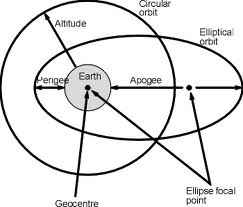
    Satellites usually start out in an orbit that is elliptical. The ground control station controls small onboard rocket motors to provide correction. The goal is to get the orbit as circular as possible. By firing a rocket when the orbit is at the apogee of its orbit (its most distant point from Earth), and applying thrust in the direction of the flight path, the perigee (lowest point from Earth) moves farther out. The result is a more circular orbit.